
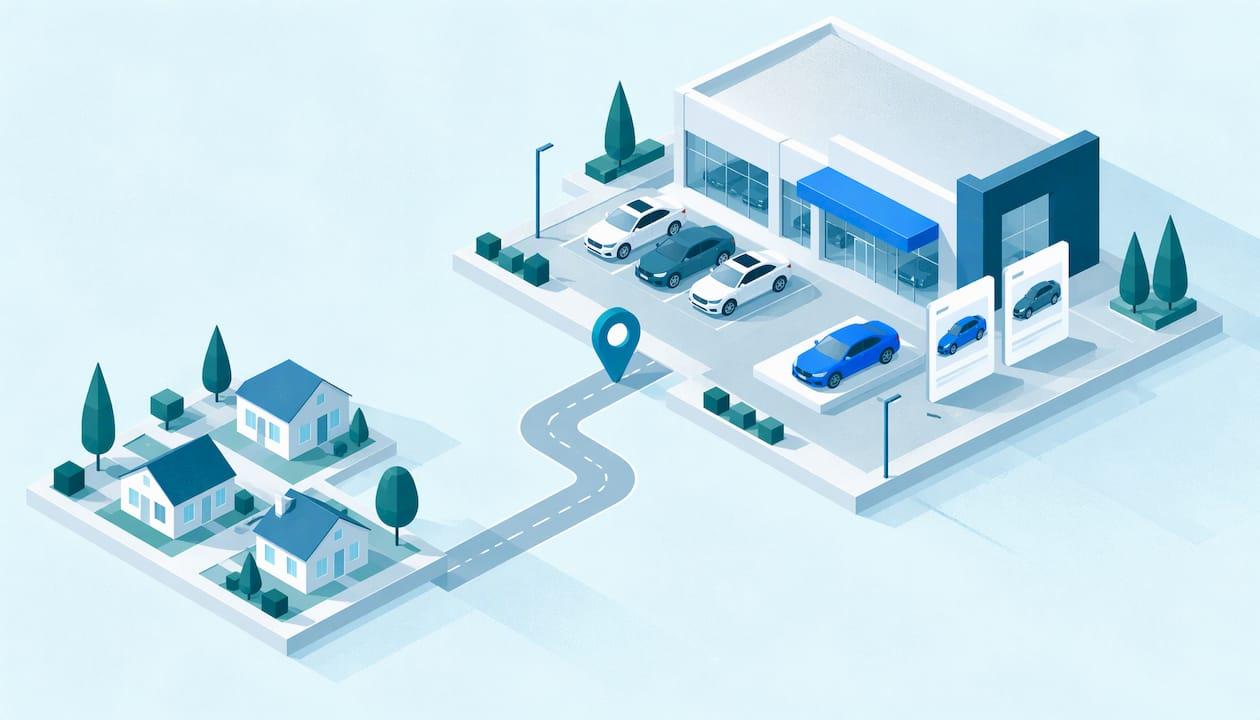
SEO for a car dealership means making your store show up when people near you search for a vehicle or a repair: in the map results, in organic listings and, increasingly, in AI-generated answers. It works when you treat sales, service and parts as separate searches, keep your inventory pages fast and crawlable, and measure calls, forms and appointments instead of rankings. This guide explains each piece in plain terms, shows where dealership sites usually go wrong, and covers what a dealership SEO engagement should include.
TL;DR
- Dealership SEO has three jobs: appear in the local map results, rank your inventory, service and location pages, and be quotable in AI answers.
- Google bases local results on relevance, distance and prominence. You cannot pay for a better local ranking, so accuracy, reviews and local links do the work.
- Sales, service and parts attract different searches and need their own pages and their own strategy.
- Slow, bloated vehicle pages hurt. Fix the pages that already get the most traffic first.
- Judge results by calls, form fills, appointments and CRM leads, not by ranking screenshots.
Table of Contents
- Why dealerships need their own kind of SEO
- The three places buyers find you
- Build your Google Business Profile the way Google expects
- Treat sales, service and parts as separate searches
- Make inventory pages fast, complete and crawlable
- Reviews, local links and the prominence signals
- Content that serves buyers at each stage
- How to measure whether dealership SEO is working
- What dealership SEO services should cover
- How we approach it at Hookd
- A 90-day starting plan
- FAQ
- Sources
Why dealerships need their own kind of SEO
A dealership is unusual among local businesses. You sell a high-ticket product that changes daily, because your inventory turns over. You also run a second business, the service department, that depends on repeat local customers. And you compete with national marketplaces, manufacturer sites and the dealer down the road, all at once.
Google's own Dealer Guidebook frames it this way: search strategy should cover the whole customer journey, put ready-to-buy searches first, use location targeting and define how you will measure success. It also names used-vehicle campaigns and fixed operations (service and parts) as growth opportunities specific to dealerships. The guidebook dates from 2016 to 2018, so treat it as the underlying logic rather than the latest tactics. The logic still holds: be present at the moment of intent, near the buyer, and count what matters to the business.
That is also why generic "SEO for small business" advice falls short. A plumber needs a service-area page and a phone call. A dealership needs thousands of constantly changing vehicle pages to stay indexed, a service department that ranks for "brake repair near me", and a way to tie both to showroom visits.
The three places buyers find you
1. The local map results
When someone searches for a dealer or a repair near them, Google often shows a map with three listings above the regular results. Getting into that group is the single most valuable local placement for most dealerships, and it runs through your Google Business Profile.
Google says local results are based mainly on relevance, distance and prominence. Relevance is how well your profile matches the search. Distance is how far you are from the searcher. Prominence reflects how well known you are, and Google says it can include links from other websites, review count and review score. You control relevance and prominence. You cannot control distance, which is why the physical location of a store matters and why a second rooftop needs its own accurate presence.
2. Organic results
Below the map are the regular listings: your homepage, new and used inventory pages, specials, finance pages and service pages. This is where research-stage searches ("best midsize SUV for a family", "is it worth leasing") and commercial searches ("used trucks Houston") land. Pages that answer the question clearly and load quickly earn the click.
3. AI answers and answer engines
More searchers now get a summarized answer before they see any listing. That can reduce clicks to every site, and it adds a visibility goal: being the source those answers draw from. Clear structure, real local authority and trustworthy, specific content still matter most. Our GEO and AEO services exist for exactly this, shaping your pages so generative and answer engines can understand and cite them. Classic SEO is not dead. It now has more places to win.
Build your Google Business Profile the way Google expects
The profile is where many dealerships lose ground through small errors. Google's guidelines for representing your business are plain:
- Use one accurate profile per real location.
- Use your real-world business name, the one on your signage and website, with no keywords added.
- Give a precise address, never a virtual office or a keyword-stuffed address line.
- Choose the fewest categories that represent what you are.
- Do not create duplicate profiles for the same location.
Google also says that complete and accurate information makes a business more likely to appear in relevant local results. For a dealership, "complete" means current hours (and separate hours for sales and service if they differ), the right phone numbers, a link to the right page, photos of the actual lot and showroom, and accurate descriptions of what you offer.
Two cautions. First, Google states that no one can request or pay for a better local ranking, so be skeptical of anyone who promises a guaranteed map-pack position. Second, if your group operates several brands or departments at one address, check Google's current guidelines before adding profiles, since mistakes here can trigger suspensions.
If you want a Houston-specific walk-through of the local fundamentals, our Houston local SEO checklist covers profile, citations and reviews in order.
Treat sales, service and parts as separate searches
A buyer shopping for a certified pre-owned sedan and a driver whose check-engine light just came on are different people with different urgency. Each department attracts its own searches, so each needs its own pages and its own plan. That is the practical meaning of "separate strategies" for sales, service, parts and financing.
The service side deserves special attention because it brings recurring, local, high-intent demand:
- One page per service. Oil change, brake repair, tire rotation, battery replacement, state inspection and collision repair each deserve a dedicated page rather than one long list.
- Location in the content. Mention the neighborhoods and cities you serve in natural language, plus directions and hours.
- Real trust signals. Technician certifications you hold, warranty terms you actually offer, genuine customer testimonials and photos of your own bays.
- Short FAQs. Answer what customers ask on the phone: how long a brake job takes, whether you service other brands, whether appointments are required.
On the sales side, build pages around the way people search: model and trim, new versus used versus certified, body style, price range and financing. Add your city or region where it fits the content, not stuffed into every line.
Make inventory pages fast, complete and crawlable
Your search-result pages (the filtered lists of vehicles) and vehicle detail pages are the heart of the site. They change daily as cars arrive and sell. Search engines can only rank them if they can reach them, read them and trust that they are current.
That means:
- Each vehicle has a unique, indexable page with complete details: year, make, model, trim, mileage, price, VIN, photos and a plain-language description.
- Sold vehicles are handled deliberately, so shoppers and Google do not land on dead ends.
- Filter and sort combinations do not create thousands of near-duplicate URLs.
- URLs and image descriptions are clear to people and machines.
Speed is the other half. Digital Dealer reported on September 29, 2025 on an Overfuel study of 1,910 retail websites from the 50 largest North American dealership groups, and its headline finding was that top dealership sites overwhelmingly fail Google's performance standards. The coverage recommends a practical order of work: measure your busiest search-result and vehicle pages with real-world user data, optimize images, defer code that is not needed at load, reserve space for banners and ads so the layout does not jump, and set performance standards for third-party vendors such as chat widgets and trade-in tools.
That last point is easy to miss. Many dealership slowdowns come from scripts a vendor added, not from the site itself. Google's Dealer Guidebook makes the same case for a simple, fast site experience tied to business objectives.
This is where a technical SEO audit earns its keep. An audit shows which templates are slow, which pages are not indexed and which duplicate URLs waste crawl attention, so you fix the biggest problems first rather than guessing.
Reviews, local links and the prominence signals
Google lists review count, review score and links from other sites as parts of prominence. For a dealership that translates into three habits.
Ask for reviews after every sale and every service visit. Service customers are often the largest source of fresh, local reviews. Ask close to the moment of satisfaction, make the link easy and reply to every review, good or bad, in a calm, specific tone.
Earn local links. Sponsor a youth league, join the chamber of commerce, host a charity drive, partner with local employers, or be included in local "best of" and community news coverage. Links from relevant local organizations carry more meaning than a bulk directory submission. Our authority and link building work focuses on this kind of earned authority, and the link building case study shows how we approach it.
Keep your name, address and phone number identical everywhere. Inconsistent listings confuse both customers and search engines, particularly if a store has moved, rebranded or changed ownership.
Content that serves buyers at each stage
Google's guidance to cover the full journey translates into a simple content map:
| Stage | What the buyer searches | Page that answers it |
|---|---|---|
| Research | "lease vs buy", "best 3-row SUV" | Helpful guides and comparisons |
| Shortlist | "used F-150 near me", "certified pre-owned Houston" | Inventory and model pages |
| Ready to act | "dealer near me", "trade-in value" | Location, trade-in and finance pages |
| Ownership | "brake repair near me", "oil change coupon" | Service department pages |
Write for the person, not the algorithm. Describe things clearly, use ordinary words and answer the question in the first lines. Local detail makes content hard to copy: how your trade-in appraisal works, which roads your delivery covers, what Gulf Coast humidity does to batteries. Our content marketing strategy service builds this kind of targeted content around the searches that lead to enquiries.
How to measure whether dealership SEO is working
Rankings are a poor scoreboard. A dealership can rank first for a phrase nobody converts on. Measure the chain from visibility to a car leaving the lot:
- Visibility. Google Search Console reports impressions and clicks by search query, page and country, and it includes indexing, sitemap and Core Web Vitals reports. Use it to confirm your inventory pages are indexed and to see which queries bring visits.
- Behavior. In your analytics, watch how visitors use search-result and vehicle pages: views, filter use, photo views and payment calculator interactions.
- Conversions. Track phone calls, form fills, chat starts, credit applications, trade-in requests and appointment bookings as separate events. Different forms signal different intent.
- Business outcomes. Match leads to your CRM to see appointments, showroom visits and sales. Google's Dealer Guidebook lists conversion tracking, analytics, store visits and attribution among the measurement capabilities dealerships should use.
Treat correlation carefully. A traffic rise in the same month as a manufacturer incentive does not prove SEO caused sales. Compare organic leads to organic leads from a year earlier, separate branded searches (people already looking for you) from non-branded ones, and read the trend over months, not days.
What dealership SEO services should cover
When you evaluate a provider, look for a program that covers six areas: technical health, content, local presence, inventory and vehicle page handling, measurement and clear governance of who changes what. Be wary of guaranteed rankings, since no one controls Google's results, and of reports that show only rankings and traffic.
Also ask about how inventory and your website platform will be handled. Many dealership sites run on platforms where templates, feeds and third-party scripts are managed by the vendor, so SEO work often means coordinating with them. A good engagement defines who does what from the start.
How we approach it at Hookd
We are a Houston SEO agency that turns organic traffic into measurable leads. Our process runs in three stages: discovery, strategy and execution. We start by understanding your market, locations and goals, then build a plan, then carry it out and report on it. Our work includes technical audits, authority link building, targeted content and local SEO that uses geographic intent to improve visibility on Google Maps and in local searches.

For a dealership, the natural starting point is our local SEO service, which focuses on map and local search visibility, paired with a technical SEO audit of your site. If you want to talk through your stores and goals, start at hookdseo.com. We focus on converting visibility into leads and revenue rather than vanity metrics, and we work with clients through project-based or ongoing retainer engagements.
A 90-day starting plan
Days 1 to 30: fix the foundation. Verify and correct your Google Business Profile for each real location. Run a technical audit. Identify the vehicle and service pages with the most traffic and the slowest load times. Set up call, form and appointment tracking.

Days 31 to 60: strengthen the pages that earn money. Build or rewrite dedicated service pages. Improve photos, descriptions and speed on the busiest inventory templates. Start a steady review request routine after sales and service visits.
Days 61 to 90: build authority and read the data. Begin earning local links through sponsorships and community partnerships. Publish two or three genuinely useful local guides. Review Search Console and your CRM to see which queries and pages produce enquiries, then decide where to invest next.
SEO compounds. The early weeks fix errors and unlock indexing; later months bring the authority. Set expectations in months, and judge by leads.
FAQ
Does SEO really work for car dealerships?
Yes, because buyers and service customers search locally before they visit. Google's own dealership guidance recommends prioritizing ready-to-buy searches, using location targeting and measuring conversions. The results come from the map listings, the inventory and service pages, and the reviews and links that build prominence.
How long does dealership SEO take?
There is no fixed timeline. Technical fixes and a corrected Google Business Profile can show effects sooner, while content and local authority build over several months. Plan to review leads quarterly rather than expecting a change in weeks.
Can I pay Google to rank higher in the local map results?
No. Google states that no one can request or pay for a better local ranking. Results depend on relevance, distance and prominence, which you improve with accurate profile details, reviews and links from local sites.
Is SEO dead because of AI search?
No, it is changing. Traditional search still drives discovery, while AI summaries add a new place to be visible and can reduce clicks. Clear structure, relevant content and real authority matter in both, which is why we pair classic local SEO with answer engine and generative engine optimization.
What should I track to know if my SEO provider is delivering?
Track calls, form submissions, appointments and CRM leads from organic search, alongside Search Console impressions and clicks. Rankings alone do not show whether more buyers or service customers are contacting you.
Sources
- The Dealer Guidebook (Google)
- Guidelines for representing your business on Google
- Tips to improve your local ranking on Google
- Top Auto Dealership Websites Overwhelmingly Fail Google Performance Standards (Digital Dealer)
- How to use Search Console (Google Search Central)